



Shared Legacies event brings campus and community together for dialogue and reflection
Film and discussion explore shared history and common ground as part of Dynamic Discussions Initiative

UC Davis students, faculty, staff and community members gathered on a Friday afternoon at the School of Law for a screening of Shared Legacies: The African American–Jewish Civil Rights Alliance, followed by a panel discussion and community reception. Part of the university’s Dynamic Discussions initiative, the April 24 event created space for more than 100 registrants to engage in dialogue about the historic partnership between Black and Jewish communities during the Civil Rights Movement. Through film and conversation, attendees explored themes of coalition-building, shared struggle and the enduring connections between communities.
School of Law Dean Jessica Berg and Vice Chancellor for Inclusive Excellence Renetta Tull opened the event with brief remarks. Drawing on the Dynamic Discussions Deck—developed by UC Davis Inclusive Excellence to foster thoughtful, respectful conversation grounded in the Principles of Community—Tull invited attendees to reflect on a series of prompts designed to support the conditions for community building and dialogue. Prompts included questions such as What’s a misconception about your background or culture that you wish more people understood? and What’s a time you learned something surprising from someone with a different background or belief? The prompts, selected by event moderator Bruce Haynes, Ph.D., UC Davis emeritus professor of sociology, reinforced the role of dialogue to build connection in challenging times.
Panel discussion deepens conversation and connection
After introductory remarks, attendees viewed the film and participated in a moderated Q&A that extended the conversation beyond the screen. Centering the deep collaboration between Black and Jewish leaders and activists, the film highlights how both Black and Jewish communities continue to carry the lasting impacts of historical trauma. The documentary, produced by the nonprofit Spill the Honey, features rare archival footage and firsthand accounts from key figures including Congressman John Lewis, Ambassador Andrew Young, Dr. Clarence Jones, and Rabbi Capers C. Funnye of Beth Shalom B’nai Zaken Ethiopian Hebrew Congregation. “The effects of slavery are still very prominent, just as the effects of the Holocaust are still very prominent amongst our brothers and sisters in the Jewish community,” Funnye notes in the film.
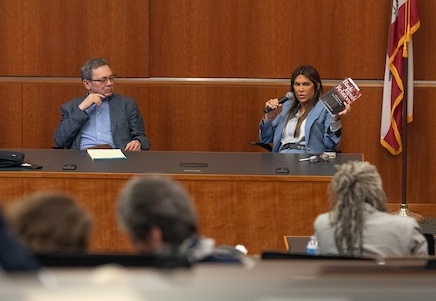
Following the screening, attendees heard from a panel featuring the filmmaker, Shari Rogers, Ph.D., in conversation with Kevin R. Johnson, J.D., UC Davis emeritus professor of law.
Drawing from her work as a clinical psychologist and documentarian, Rogers spoke to the importance of storytelling in preserving history and shaping how communities understand one another, particularly in highlighting the longstanding alliance between Black and Jewish communities, "knowing that our two communities have something important to say about democracy and human dignity and human connections," Rogers, said.
Johnson situated the film within a broader framework of social justice movements and coalition-building, connecting its historical narrative to contemporary conversations about equity, identity and the law. As moderator, Haynes guided the conversation around the ways Black and Jewish identities in the United States communities have shaped by both shared histories and evolving social contexts. He shared insights on how relationships between communities are formed, challenged and sustained over time. "You have to look each other in the eye. You have to really have empathy for somebody else who is different than yourself and be able to listen to ideas that maybe you disagree with,” Haynes said.

Together, the panelists emphasized a central theme of the event: that meaningful progress often emerges from solidarity across communities, grounded in shared values, mutual understanding and a willingness to work collectively toward justice. Audience members contributed questions, creating a dynamic exchange that extended the film’s message and encouraged reflection on how its lessons apply today.
Campus and community partnerships power collaborative event
The event was presented through a broad collaboration of campus and community partners, including the African American Faculty and Staff Association (AAFSA), the African American Studies Department, the Aoki Center for Critical Race and Nation Studies at UC Davis School of Law, Congregation Bet Haverim, the Department of History, the Jewish Culture, Heritage, and Identity Faculty Staff Association (JCHAI), the Jewish Studies Program and Inclusive Excellence. The event served as an early kickoff to Jewish American Heritage Month, observed nationally each May, offering a timely opportunity to reflect on Jewish history, identity and contributions alongside the film’s focus on cross-community partnership.
Organizers worked across departments, centers and community organizations to bring the program to campus as part of a larger weekend of events connected to the film, including additional gatherings in community spaces beyond campus. Open to the public, the screening welcomed a wide audience of students, faculty, staff, alumni and local residents. Participants included members of synagogues in Davis and Sacramento as well as members from various community organizations including the local Hate Free Together coalition. Before and after the program, attendees gathered in the law school courtyard for refreshments and informal conversation, creating space to continue dialogue and build connections.
“This event was part of our Dynamic Discussions effort, and it reflects the strength of collaboration across our campus and community partners. I am so pleased that faculty engaged with their students, and so many groups came together to support and share this important history and create space for meaningful dialogue and connection,” Tull said after the event. “This event was open to all members of our campus and the local community, from any background, and with any viewpoint. It was a nice way to come together over food, history, and conversation,”
